BSc Disaster Risk Analytics
UCL Department of Risk and Disaster Reduction
Draft for consultation, November 2026. The programme is subject to UCL approval; module descriptions may change.
Modules by stream and by year and term
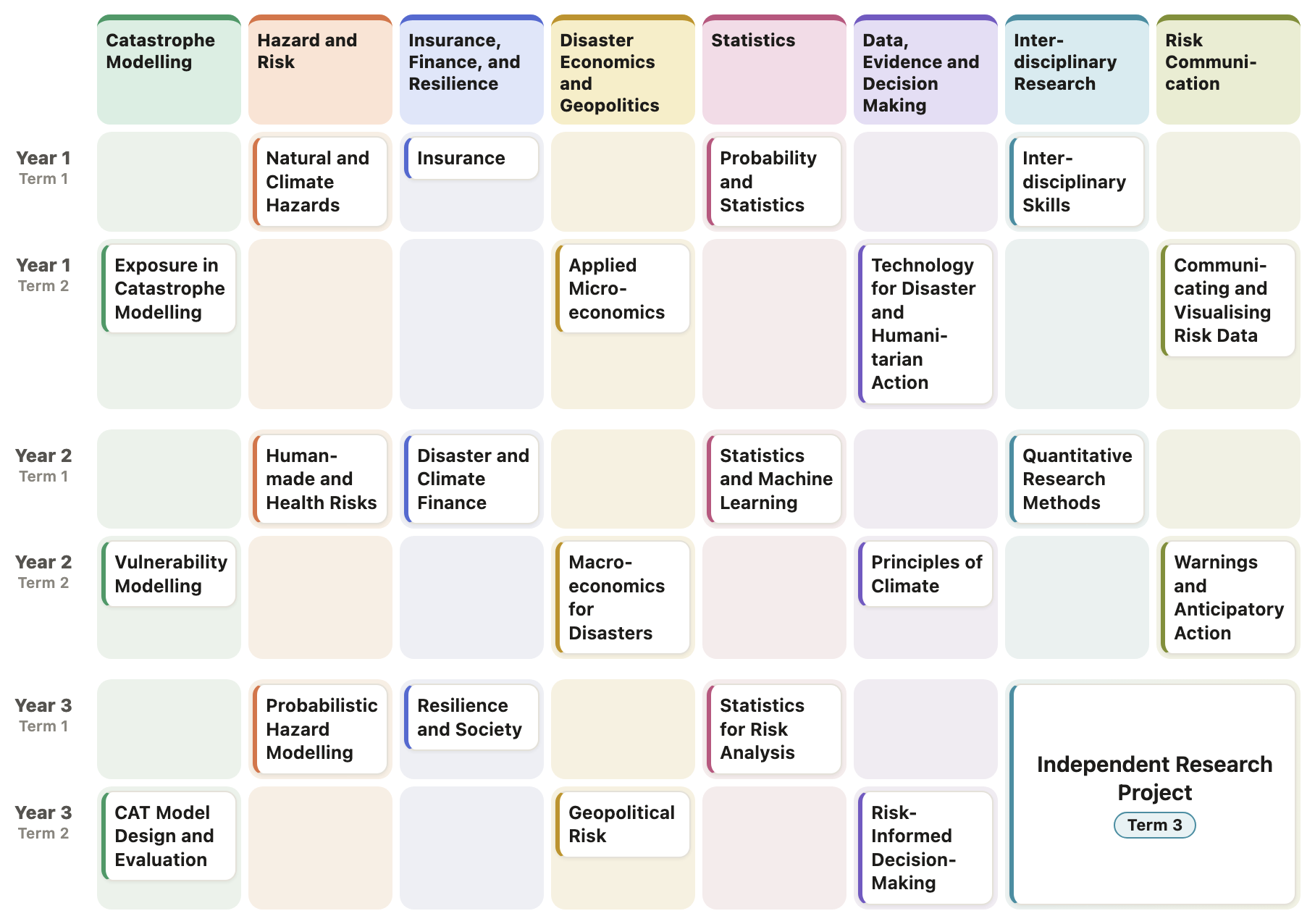
Modules by stream, with their contents
| Catastrophe Modelling | |
|---|---|
| Exposure in Catastrophe ModellingYear 1 · Term 2 | Exposure data for catastrophe models: building attributes, data standards, geocoding, data quality and accumulation management. |
| Vulnerability ModellingYear 2 · Term 2 | Modelling how earthquakes, floods and windstorms damage buildings, and how that damage becomes financial loss. |
| CAT Model Design and EvaluationYear 3 · Term 2 | Building, calibrating and validating a catastrophe model end to end, evaluating commercial models and forming a view of risk. |
| Hazard and Risk | |
| Natural and Climate HazardsYear 1 · Term 1 | Earthquakes, volcanoes, cyclones, heatwaves, droughts, floods and sea level rise, and how climate change affects them. |
| Human-made and Health RisksYear 2 · Term 1 | Technological, nuclear, cyber, systemic and health risks, including epidemic and pandemic modelling. |
| Probabilistic Hazard ModellingYear 3 · Term 1 | Probabilistic hazard analysis for earthquake, flood and wind, and combining the perils. |
| Insurance, Finance, and Resilience | |
| InsuranceYear 1 · Term 1 | The principles, markets and products of insurance and reinsurance, including catastrophe insurance and protection gaps. |
| Disaster and Climate FinanceYear 2 · Term 1 | Financing disaster and climate risk beyond conventional insurance, from sovereign disaster risk financing and insurance-linked securities to climate and adaptation finance. |
| Resilience and SocietyYear 3 · Term 1 | How societies reduce risk and build resilience, from households and infrastructure to governance and climate adaptation. |
| Disaster Economics and Geopolitics | |
| Applied MicroeconomicsYear 1 · Term 2 | How individuals, households and firms make decisions under scarcity and risk, with the economics of disasters and climate change. |
| Macroeconomics for DisastersYear 2 · Term 2 | How disasters affect economies and public finances, and how economic systems shape risk, recovery and resilience. |
| Geopolitical RiskYear 3 · Term 2 | Analysing, measuring and forecasting geopolitical risk and conflict, including political violence and war in insurance. |
| Statistics | |
| Probability and StatisticsYear 1 · Term 1 | Probability and statistics to describe and simulate risk from hazard and loss data, including return periods and average annual loss. |
| Statistics and Machine LearningYear 2 · Term 1 | Regression, Bayesian inference, time series, spatial statistics and machine learning foundations for risk data. |
| Statistics for Risk AnalysisYear 3 · Term 1 | Extreme value statistics, Monte Carlo simulation, dependence, emulators and AI methods for estimating rare losses and analysing complex risk data. |
| Data, Evidence and Decision Making | |
| Technology for Disaster and Humanitarian ActionYear 1 · Term 2 | Programming, online data portals, Earth observation, drones and geospatial mapping for disaster and humanitarian work. |
| Principles of ClimateYear 2 · Term 2 | The physics of the climate system, the drivers and impacts of climate change, and the tools used to observe and model it. |
| Risk-Informed Decision-MakingYear 3 · Term 2 | Using risk evidence to make and defend decisions, from retrofit and adaptation investment to warnings and insurance purchasing. |
| Interdisciplinary Research | |
| Interdisciplinary SkillsYear 1 · Term 1 | Critical thinking, professionalism, secondary data analysis and communicating evidence. |
| Quantitative Research MethodsYear 2 · Term 1 | Designing and critically reading quantitative research based on measurements from instruments, sensors, remote sensing and fieldwork. |
| Independent Research ProjectYear 3 · Term 3 | Students design and conduct their own independent research project. |
| Risk Communication | |
| Communicating and Visualising Risk DataYear 1 · Term 2 | Communicating risk and uncertainty clearly through numbers, graphics, maps, dashboards, writing and presentations. |
| Warnings and Anticipatory ActionYear 2 · Term 2 | Designing, communicating and evaluating warning systems, and acting early on forecasts through anticipatory action and its financing. |